 Belt finance
 Pending Deposit and Withdrawal Checks
Belt finance deposits and withdrawals need different follow-up actions depending on whether the transaction remains pending, failed during execution or completed with an unexpected balance. Before retrying, match the transaction to the account, network and vault that you used. Then compare its status with the underlying asset and receipt-token movements. A successful approval alone does not establish a deposit. A completed redemption needs a matching return of assets, while an unresolved transaction can still execute. Waiting suits an outstanding submission; reconciliation suits a completed operation. A fresh attempt makes sense only after the earlier transaction is resolved and the cause of any failure is understood.
Last updated -Receipt movements separate completion from a pending request
A beltToken represents a vault deposit, so its movement helps distinguish an executed operation from an interface that is still waiting. Deposit receipts and transaction receipts are different objects. The beltToken records a position; the transaction receipt records execution. Neither a spinning button nor an unchanged portfolio valuation settles whether the intended operation completed.
For a direct vault deposit, examine the underlying assets leaving the account and the vault receipts arriving. For native BNB deposits or withdrawals, inspect native-asset movements too and account separately for gas costs when comparing wallet balances. Redemption reverses that relationship: receipts are burned and underlying assets return. Receipt quantities need not equal underlying quantities because shares represent a claim on the vault. Compare each movement in its own token units rather than expecting identical numbers.
The account, network and transaction behind the discrepancy
The transaction hash identifies the submission to investigate, while the sender and network establish whose balances belong in the comparison. Preserve that hash before closing an error message. Match the receiving contract to the vault or intermediary that the transaction actually called. A familiar token symbol cannot establish that relationship.
A transaction receipt includes execution status, block information and logs. Pending transactions do not yet have an execution receipt. An empty lookup therefore leaves the outcome unresolved; it does not prove failure. Check whether the transaction appears under the account’s activity and whether a replacement hash exists.
Approval success and an unfinished deposit
A token approval authorizes spending by a particular contract. It does not itself move the approved tokens into a vault. When an approval succeeds but the asset balance stays unchanged, first establish whether a separate deposit transaction exists. Repeating the approval will not complete that missing operation.
The allowance belongs to a specific spender
An allowance connects the token owner, token contract and authorized spender. Permission granted to a different contract does not authorize the intended deposit. The remaining allowance can also differ from the amount originally approved after spending occurs. Read the allowance that applies to this operation before treating another approval as necessary.
The successful transaction may be the wrong step
The transaction’s method and logs distinguish an approval from a transfer or vault call. That explains why a green confirmation can coexist with an unfinished deposit. The ERC-20 token standard defines approval and transfer as separate operations.
Pending submissions and replacement transactions
A pending submission has an unresolved execution outcome, so creating another deposit or withdrawal can introduce a second operation. For ordinary transactions sent from the same externally owned account, the nonce determines their order. An earlier pending nonce can hold up later submissions even when those later transactions offer higher fees.
Waiting preserves the original request without paying for a replacement. A wallet-supported speed-up attempts to replace that request using the same nonce and different fee settings. The required fee depends on the network and transaction type; no fixed percentage or waiting period applies universally. A replacement also needs to reach the network before the original completes.
Cancellation is another replacement attempt, not an instruction that erases a confirmed operation. Follow the status of the replacement as well as the original hash. An ordinary new transaction with a different nonce does not cancel the earlier request.
Successful execution with an unexpected balance
A successful status establishes that the submitted transaction executed, but its actual effects still need to match the intended deposit or withdrawal. Read the called method and asset movements before assuming the interface has lost a position.
Receipt quantities and the displayed valuation
A receipt balance measures shares, while a portfolio display may show an estimated value of their underlying assets. Those figures answer different questions. A changed valuation without a matching transfer does not establish that another deposit occurred. Reconcile the minted or burned receipt quantity separately from the value that the interface assigns to it.
Historical balance comparisons also need a consistent interval. Later transfers can obscure the change caused by the transaction under review. Use its recorded movements to isolate the operation, then account for subsequent activity when comparing them with the balance visible now.
Wallet holdings and a separate position
A receipt that subsequently moved into another contract will not remain in the wallet’s token balance. Where a separate staking transaction exists, inspect the corresponding position record. Keep vault redemption distinct from unstaking: one changes the underlying vault claim, while the other changes where that claim is held.
An approval, unstaking transaction or reward claim can succeed without completing the intended redemption. The method that executed determines the next task. Avoid repeating the entire sequence simply because the final asset balance has not appeared.
A failed execution and the remaining cost
A reverted transaction still incurs a fee for the gas consumed during execution. A top-level revert undoes the state changes made by that transaction’s contract execution. Treat a recorded failure differently from a timeout that returned no outcome. Earlier successful approvals or other separate transactions remain in effect.
Minimum output and strategy constraints
Belt’s multi-strategy vault implementation checks minimum shares on deposits and minimum returned assets on withdrawals. A failed minimum check concerns the execution result, not how long the transaction waited. Lowering the minimum permits a worse result; it is not a neutral repair.
The same implementation includes separate deposit and withdrawal pause controls, active-strategy checks and a withdrawal-size constraint. These conditions can change. Its maximum-withdrawal estimate does not guarantee successful redemption. A smaller request may address a size constraint, but cannot by itself resolve a pause or failing strategy. These are properties of the multi-strategy vault implementation, not confirmation that a particular deployed vault is currently available.
Waiting, replacing, reconciling, retrying and stopping
The appropriate response follows the observed transaction state. Elapsed time alone cannot distinguish a congested submission from a failed contract call or a completed operation. The options below address different problems; changing between them requires new information about the transaction or vault.
| Response | Matching condition | Condition for progress |
|---|---|---|
| Wait | The original transaction remains pending and its request remains acceptable | Inclusion depends on network conditions and the account’s transaction order |
| Replace | A pending transaction needs a wallet-supported speed-up or cancellation | The replacement must be included in the chain instead of the original transaction |
| Reconcile | Execution succeeded but the displayed position differs from expectations | The method, asset movements and position records explain the difference |
| Retry | The earlier attempt failed and its specific cause has been addressed | The new request satisfies the applicable execution conditions |
| Stop | Contract identity, operation availability or the prior outcome remains unresolved | The missing information is resolved before another signature |
The limits of a refreshed quote
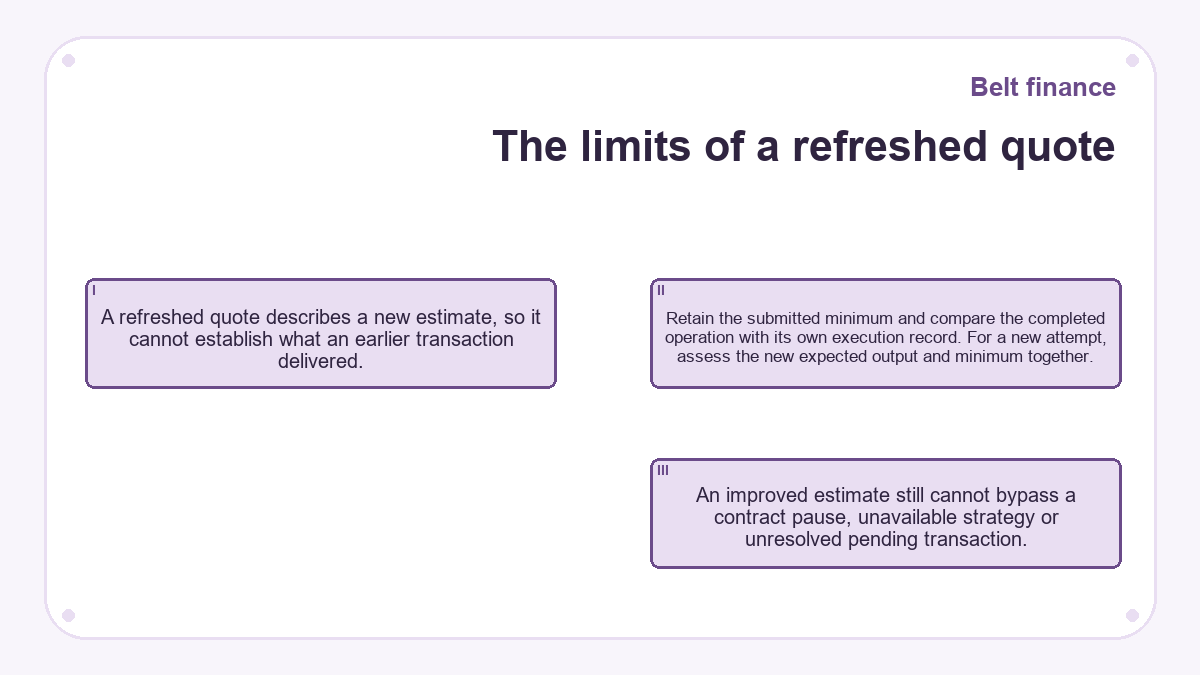
A refreshed quote describes a new estimate, so it cannot establish what an earlier transaction delivered. Retain the submitted minimum and compare the completed operation with its own execution record. For a new attempt, assess the new expected output and minimum together. An improved estimate still cannot bypass a contract pause, unavailable strategy or unresolved pending transaction.
Unresolved records before another signature
An unresolved discrepancy needs the transaction hash, sender, network, called contract and relevant token movements kept together. These records make it possible to distinguish execution failure from an accounting or display problem. A screenshot of a missing balance usually omits the method and execution status that explain the difference.
Balance and transaction lookups do not require a deposit, token approval or recovery phrase. Stop if a supposed reconciliation process asks for one of those merely to inspect public records. Resume only when the earlier outcome is clear and the proposed transaction addresses the remaining task. If the original operation has already completed, the next action is reconciliation rather than another deposit or withdrawal.
Popular questions about Belt finance
Can closing the browser cancel a pending Belt finance withdrawal?
Closing the browser does not cancel a transaction that has reached the network. The submission can continue toward execution without the page remaining open. Preserve its hash so that you can inspect the outcome after reopening the wallet. Closing an unsigned confirmation window is different because that request has not yet been authorized.
Does a failed deposit mean I must approve the token again?
A failed deposit does not automatically remove an approval that succeeded in a separate transaction. The relevant value is the remaining allowance for the intended spender. Another operation may have changed that allowance, so neither the earlier approval amount nor the failed deposit alone establishes whether fresh permission is needed.
Why does clearing wallet activity leave my withdrawal unresolved?
Clearing local wallet activity does not change the transaction’s state on the blockchain. It removes local records and can hide information useful for reconciliation. Keep the transaction hashes before troubleshooting the wallet display. A pending submission still needs its network outcome resolved even when the wallet no longer shows it.
How should I reconcile two withdrawal hashes after using speed-up?
Compare the sender and nonce to determine whether the hashes represent competing versions of the same transaction. For ordinary transactions from an externally owned account, only one transaction with that nonce can remain included in the canonical chain. Use the included transaction’s execution record when reconciling the withdrawal, rather than adding both requested amounts.
When can a withdrawal quote differ from the amount that arrived?
A quote can differ when the conditions used to calculate it change before execution. The submitted minimum sets an execution constraint where the chosen withdrawal method supports it. Reconcile the received amount against the completed transaction and that minimum, rather than against a quote refreshed after the withdrawal.