 Belt finance
: Deposit Checklist From Wallet Checks to Confirmation
Belt finance vault deposits require matching the wallet account, network and accepted asset to the selected vault. Review any token allowance before signing, then inspect the deposit request itself. Completion means a successful deposit transaction and the corresponding beltToken receipt. An approval confirmation alone does not establish that the vault received your deposit.
Last updated -The approval deserves separate attention because it grants spending authority before the deposit executes. Keep the intended deposit amount, expected receipt token and transaction details available while reviewing both requests. Deposit availability remains specific to the selected vault and its operating state.
A token approval creates spending permission before the deposit, so review its scope before treating the deposit signature as your commitment point.
Wallet and asset matching before confirmation
The selected vault determines the accepted asset and expected beltToken receipt, so establish that relationship before opening a signing request. Match the connected account to the account holding the asset. Check the network and token contract rather than relying on the displayed ticker. Keep enough native currency available for network fees, including a separate approval where required. A successful deposit record must correspond to that same account, vault and receipt token.
Allowance scope before the deposit
The spender is the contract receiving permission, which is different from the token contract whose allowance you are changing.
A standard token allowance authorizes a spender to transfer up to the permitted amount of that token. Review both addresses and the requested spending cap. A familiar application name does not establish which contract receives permission.
A cap matching the intended deposit limits the amount available through that permission. A larger cap leaves room for subsequent spending, potentially including tokens acquired later. Neither choice establishes that the spender is trustworthy. Permission size and contract identity answer different questions.
Changing the deposit amount after approval may leave the allowance insufficient or larger than intended. Read the actual allowance before granting another one. Existing permission can remove the need for a fresh approval, but it still deserves review. Native-asset deposits follow a different authorization path and do not use an allowance for the native currency itself.
What does the final deposit signature commit?
The deposit signature authorizes the transaction that submits assets to the vault, while an earlier approval already grants token access. If you require spending permission to remain unchanged until the deposit signature, a workflow with a separate prior approval does not meet that requirement.
Inspect the selected account, network, destination contract and asset amount in the wallet request. Where the wallet decodes the operation, check that it describes the intended deposit. An unexplained transfer or approval deserves rejection before signing. A simulation can describe expected effects, but execution still depends on the contract state when the transaction runs.
Rejecting an unsigned request stops that request from being submitted through the wallet. Once a signed transaction reaches the network, cancellation is uncertain. Successful execution cannot be undone by dismissing the confirmation window. Withdrawing afterward is a separate contract operation.
Review deposit costs before this boundary. Network fees pay for execution; strategy entrance fees, where applicable, affect the assets represented by the receipt. The documented multi-strategy design includes strategy-dependent deposit charges, so a displayed deposit amount does not establish the eventual redeemable amount. Withdrawal can introduce further costs and liquidity constraints.
The beltToken receipt and transaction record
The receipt must belong to the vault that accepted the deposit, and its quantity need not equal the quantity of underlying tokens supplied. A beltToken represents a share of the assets in its associated vault. Compare the receipt contract and credited quantity with the completed deposit rather than expecting matching token counts.
Keep the deposit transaction hash with the account, network and receipt contract. Successful execution establishes that the transaction ran; its token movements establish what reached the account. The share conversion and applicable deposit charges explain the relationship between input and receipt. Later yield farming or staking involves an additional position and should not be mistaken for the initial deposit confirmation.
An unchanged deposit balance after approval
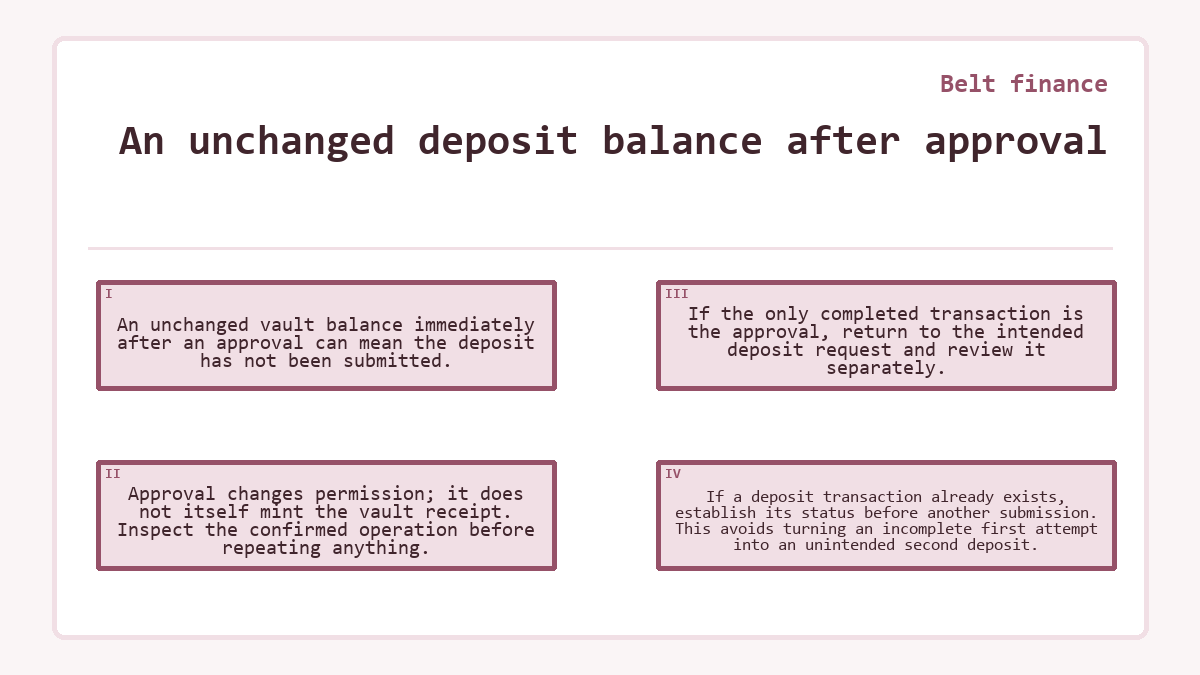
An unchanged vault balance immediately after an approval can mean the deposit has not been submitted. Approval changes permission; it does not itself mint the vault receipt. Inspect the confirmed operation before repeating anything. If the only completed transaction is the approval, return to the intended deposit request and review it separately. If a deposit transaction already exists, establish its status before another submission. This avoids turning an incomplete first attempt into an unintended second deposit.
Permission choices when retaining control matters
If you want to postpone spending authority until you are ready to deposit, keep the approval request unsigned during review. For a token deposit requiring an allowance, compare each available permission choice by the amount that the spender can access.
| Permission choice | Spending exposure |
|---|---|
| Reject the new approval | No new allowance is granted; an existing allowance remains unchanged. |
| Approve the intended deposit amount | The spender can access up to that amount under the allowance. |
| Approve a larger finite amount | Permission beyond the deposit can remain available for later spending. |
| Approve an effectively unlimited amount | The allowance generally does not meaningfully restrict access to that token balance. |
Suppose your intended choice is an approval limited to the deposit amount. The wallet request should show that cap and the intended spender. If it instead shows substantially broader access, reject or edit the request before signing. Once approval executes, the spender has permission even while the deposit remains unsigned.
Leaving the deposit unfinished does not reverse an existing approval. Removing unused permission requires a separate revocation transaction and network fees. Revocation prevents future use of that allowance after it takes effect; it cannot recover tokens already transferred.
Belt finance: frequently asked questions
Can I deposit by sending tokens directly to the vault address?
An ordinary token transfer is not equivalent to calling the vault’s deposit function. The deposit operation performs the accounting that creates the receipt. Sending tokens directly to a contract can leave them without a corresponding claim for your account, so use the supported deposit operation.
Does a spending cap include the gas fee for my deposit?
A spending cap controls access to the approved token and does not include the network gas fee. Gas comes from the account’s native currency balance. An approval and a deposit can each require a separate fee, so a sufficient token allowance does not establish sufficient funds for execution.
Why might the approval amount look different from my entered deposit amount?
The application may request a spending cap larger than the deposit, or the wallet may display token quantities using a different representation. Check the token identity, decimal formatting and cap before signing. A larger approval is a separate permission choice, not an increase in the intended deposit.
Should I approve again after switching wallet accounts?
The newly selected account has its own allowance for the token and spender. An approval from another account does not authorize spending from this one. Inspect the selected account’s existing permission before deciding whether another approval is necessary.
How can I distinguish a vault receipt from an unexpected token in my wallet?
Match the token contract to the receipt associated with the selected vault and inspect the deposit transaction’s token movements. A matching name or ticker is insufficient because another token can reuse it. An unrelated token arriving around the same time does not establish any connection to the deposit.